6 — Switching to numpyro NUTS
Since v2.5, eddy ships a JAX-backed model and supports two MCMC backends for :class:~eddy.rotationmap.rotationmap.fit_map:
mcmc='emcee'— the historical default. Affine-invariant ensemble sampler with no gradient information; needs many walkers to explore high-dimensional posteriors.mcmc='numpyro'— opt-in NUTS sampler that uses the JAX gradient of the same likelihood. Far more sample-efficient at high dimensions (typically200post-warmup samples reach a posterior resolution comparable to emcee with32 walkers × 1000 samples), at the cost of higher per-sample wall time.
Both backends agree to within sampling noise on the standard 9-parameter HD163296 3D fit (see REFACTORING_PLAN.md §5.1b); pick whichever suits the problem.
This short tutorial demonstrates the numpyro path on the same data used in Tutorial 2 <tutorial_2.html>_.
Setup
The data files are the same as Tutorial 2 — download them if you haven’t already.
[1]:
import os
if not os.path.exists('HD163296_CO_v0.fits'):
    !wget -O HD163296_CO_v0.fits -q https://dataverse.harvard.edu/api/access/datafile/:persistentId?persistentId=doi:10.7910/DVN/C2ZUNO/AWCSZR
if not os.path.exists('HD163296_CO_dv0.fits'):
    !wget -O HD163296_CO_dv0.fits -q https://dataverse.harvard.edu/api/access/datafile/:persistentId?persistentId=doi:10.7910/DVN/C2ZUNO/NGOW49
[2]:
from eddy import rotationmap

cube = rotationmap(path='HD163296_CO_v0.fits',
                   uncertainty='HD163296_CO_dv0.fits',
                   FOV=8.0, downsample=4)
Tightening unbounded priors
NUTS samples in an unconstrained parameter space and uses a bijective transform to map back to the prior support. For Uniform(lo, hi) the transform is well-conditioned only when both bounds are finite; an improper prior such as r_taper ∈ (0, ∞) (the default) maps to an unbounded log transform whose curvature is poor at large values, and NUTS trees blow up to thousands of leapfrog steps per iteration.
emcee tolerates unbounded uniforms transparently because it only inspects the bounds, but for the numpyro path it pays to tighten any inf upper or lower bound to a finite value larger than the physically interesting range. For HD163296, r_taper larger than the field of view is irrelevant, so a generous ceiling of 50″ works:
[3]:
cube.set_prior('r_taper', [0.0, 50.0], 'flat')
Setting up the fit
The free-parameter dictionary, fixed parameters, and p0 are identical to the 9-parameter 3D fit in Tutorial 2. Only the call to fit_map changes.
[4]:
params = {}
params['x0'] = 0
params['y0'] = 1
params['PA'] = 2
params['mstar'] = 3
params['vlsr'] = 4
params['z0'] = 5
params['psi'] = 6
params['r_taper'] = 7
params['q_taper'] = 8

params['inc'] = 46.7
params['dist'] = 101.0
params['r_min'] = 2.0 * cube.bmaj

p0 = [0.0, 0.0, 312., 2.0, 5.7e3, 0.25, 1.0, 3.0, 2.0]
Running the fit
The MCMC backend is selected with the mcmc= keyword. The legacy walker/burnin/step kwargs map onto numpyro’s num_chains / num_warmup / num_samples internally, so existing scripts can switch backends by changing one keyword:
================== ========================= fit_map kwarg numpyro equivalent ================== ========================= nwalkers num_chains nburnin num_warmup nsteps num_samples ================== =========================
NUTS additionally accepts a few sampler-specific kwargs through mcmc_kwargs:
seed— PRNG key seed (default0).progress— show a progress bar (defaultTrue).max_tree_depth— cap the doubling tree depth. Default is 10 (≤1024 leapfrog steps per NUTS iteration). For typicalrotationmapfits, a value of 6 (≤64 leapfrog steps) is a good default — it cuts wall time roughly in half versus the numpyro default at the cost of slightly less efficient exploration of strongly-correlated directions. Bump back up to8(≤256 steps) if you observe poor mixing or many divergent transitions.chain_method— passed through to :class:numpyro.infer.MCMC. Default'sequential'. Note that'vectorized'does not help in practice forfit_map-style fits: NUTS’ adaptive tree length is per-chain, so vmap’d chains must all run to the longest tree, cancelling the speedup.
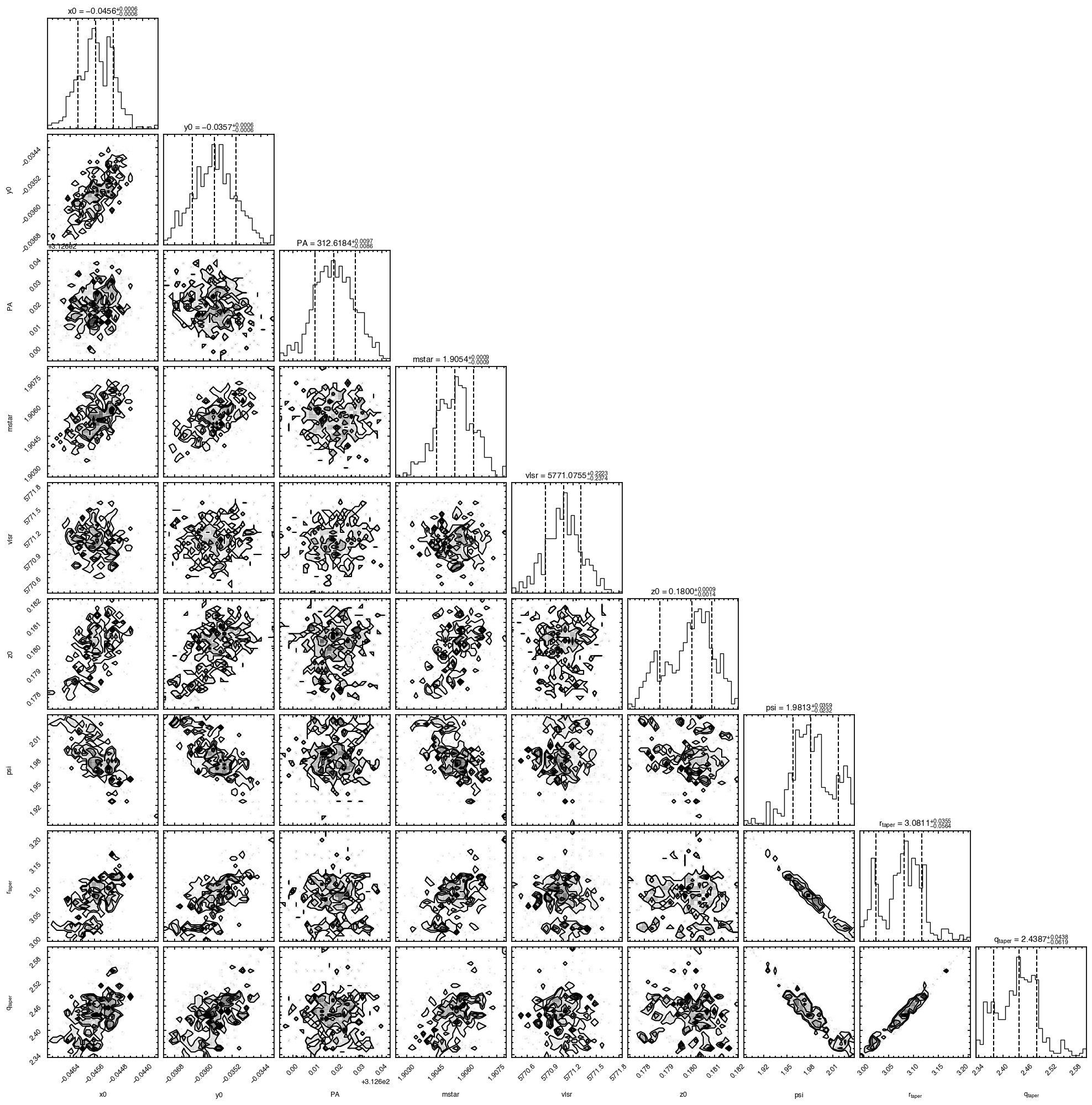
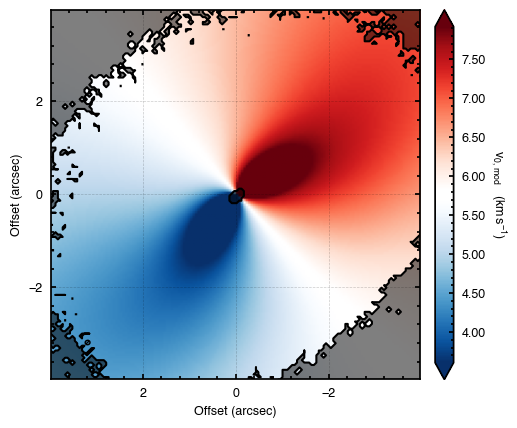
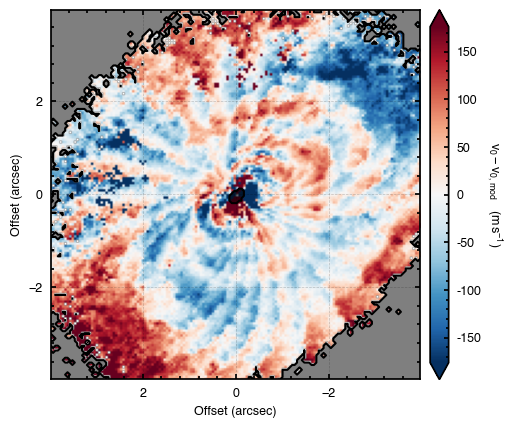
Single-chain NUTS with 500 warmup + 500 samples is a reasonable starting budget for a 9-parameter fit. The full run takes about four minutes on a modern CPU with max_tree_depth=6 and is dominated by JAX compilation and the warmup adaptation.
[5]:
samples = cube.fit_map(
    p0=p0, params=params, optimize=True,
    nwalkers=1,    # numpyro: num_chains
    nburnin=500,   # numpyro: num_warmup
    nsteps=500,    # numpyro: num_samples
    mcmc='numpyro',
    mcmc_kwargs={
        'seed': 0,
        'progress': True,
        'max_tree_depth': 6,
    },
    plots=['walkers', 'corner', 'bestfit', 'residual'],
    returns=['samples', 'percentiles'],
)
W0513 09:17:29.631477 15671963 cpp_gen_intrinsics.cc:74] Empty bitcode string provided for eigen. Optimizations relying on this IR will be disabled.
Assuming:
        p0 = [x0, y0, PA, mstar, vlsr, z0, psi, r_taper, q_taper].
Optimized starting positions:
        p0 = ['-1.39e-02', '-3.35e-02', '3.12e+02', '1.93e+00', '5.70e+03', '2.34e-01', '1.66e+00', '3.30e+00', '1.97e+00']
sample: 100%|██████████| 1000/1000 [06:12<00:00,  2.68it/s, 63 steps of size 1.28e-02. acc. prob=0.94]
/Users/richardteague/miniconda3/lib/python3.13/site-packages/numpy/lib/_histograms_impl.py:897: RuntimeWarning: invalid value encountered in divide
  return n / db / n.sum(), bin_edges
/Users/richardteague/miniconda3/lib/python3.13/site-packages/numpy/lib/_histograms_impl.py:897: RuntimeWarning: invalid value encountered in divide
  return n / db / n.sum(), bin_edges
/Users/richardteague/miniconda3/lib/python3.13/site-packages/numpy/lib/_histograms_impl.py:897: RuntimeWarning: invalid value encountered in divide
  return n / db / n.sum(), bin_edges
/Users/richardteague/miniconda3/lib/python3.13/site-packages/numpy/lib/_histograms_impl.py:897: RuntimeWarning: invalid value encountered in divide
  return n / db / n.sum(), bin_edges
/Users/richardteague/miniconda3/lib/python3.13/site-packages/numpy/lib/_histograms_impl.py:897: RuntimeWarning: invalid value encountered in divide
  return n / db / n.sum(), bin_edges
/Users/richardteague/miniconda3/lib/python3.13/site-packages/numpy/lib/_histograms_impl.py:897: RuntimeWarning: invalid value encountered in divide
  return n / db / n.sum(), bin_edges
/Users/richardteague/miniconda3/lib/python3.13/site-packages/numpy/lib/_histograms_impl.py:897: RuntimeWarning: invalid value encountered in divide
  return n / db / n.sum(), bin_edges
/Users/richardteague/miniconda3/lib/python3.13/site-packages/numpy/lib/_histograms_impl.py:897: RuntimeWarning: invalid value encountered in divide
  return n / db / n.sum(), bin_edges
/Users/richardteague/miniconda3/lib/python3.13/site-packages/numpy/lib/_histograms_impl.py:897: RuntimeWarning: invalid value encountered in divide
  return n / db / n.sum(), bin_edges
WARNING:root:Too few points to create valid contours
WARNING:root:Too few points to create valid contours
WARNING:root:Too few points to create valid contours
WARNING:root:Too few points to create valid contours
WARNING:root:Too few points to create valid contours
WARNING:root:Too few points to create valid contours
WARNING:root:Too few points to create valid contours
WARNING:root:Too few points to create valid contours
WARNING:root:Too few points to create valid contours
WARNING:root:Too few points to create valid contours
WARNING:root:Too few points to create valid contours
Wall time vs sample efficiency
NUTS is dramatically more sample-efficient than emcee. On the validation fit recorded in REFACTORING_PLAN.md §5.1b, ~500 numpyro samples reach a posterior resolution comparable to ~128 000 emcee samples — a 256× difference in raw sample count.
But each NUTS sample is much more expensive than each emcee step:
emcee evaluates the log-probability once per walker per step. Recent fit_map speedups (commits
f23cf29and867bc38) compile that into a single XLA call that vmaps across walkers, taking a 32-walker step to ~12 µs per walker-eval (warm cache).NUTS samples by tracing a Hamiltonian trajectory through the posterior, doubling the trajectory length until it U-turns. On the 9-parameter fit above, a typical iteration uses ~95 leapfrog steps (median), each requiring a gradient evaluation — roughly 2× the cost of a likelihood evaluation. So one NUTS sample does the work of ~190 emcee evaluations.
Multiply through: producing the same number of effective samples takes numpyro ~190 / 256 ≈ 0.7× the gradient work emcee does. But emcee’s per-walker cost has dropped ~16× via vmap’d batch evaluation, while numpyro can’t share that optimisation (NUTS’ tree extension is per-chain, not per-walker). So in wall time, numpyro is currently slower than emcee on most fits.
We have a tracking issue (see the GitHub repository) for further numpyro performance work. The current recommendation is:
For routine fits, stay on
mcmc='emcee'— it’s the default for exactly this reason.Use
mcmc='numpyro'when sample efficiency is the bottleneck (e.g. each evaluation is very expensive, very long autocorrelation in emcee, or running on a GPU).
Practical guidance
emcee remains the recommended default for routine fits — it’s embarrassingly parallel across walkers, has no JAX warm-up cost, and the per-walker batch is compiled into a single XLA dispatch. Switch to numpyro when one of these matches:
The posterior is high-dimensional (≳ 8 free parameters) and you’d otherwise need a very long emcee chain to bring the autocorrelation time under control.
You’re running on a GPU. numpyro inherits JAX’s device auto-detection, so a single
mcmc='numpyro'call uses the GPU without further configuration.You want the same analytic gradient that
optimize=Truealready uses internally to also drive the MCMC step.
The two backends are statistically equivalent on the validation fit recorded in REFACTORING_PLAN.md §5.1b: medians match within 0.2 σ on every parameter and posterior widths agree within 9 %.